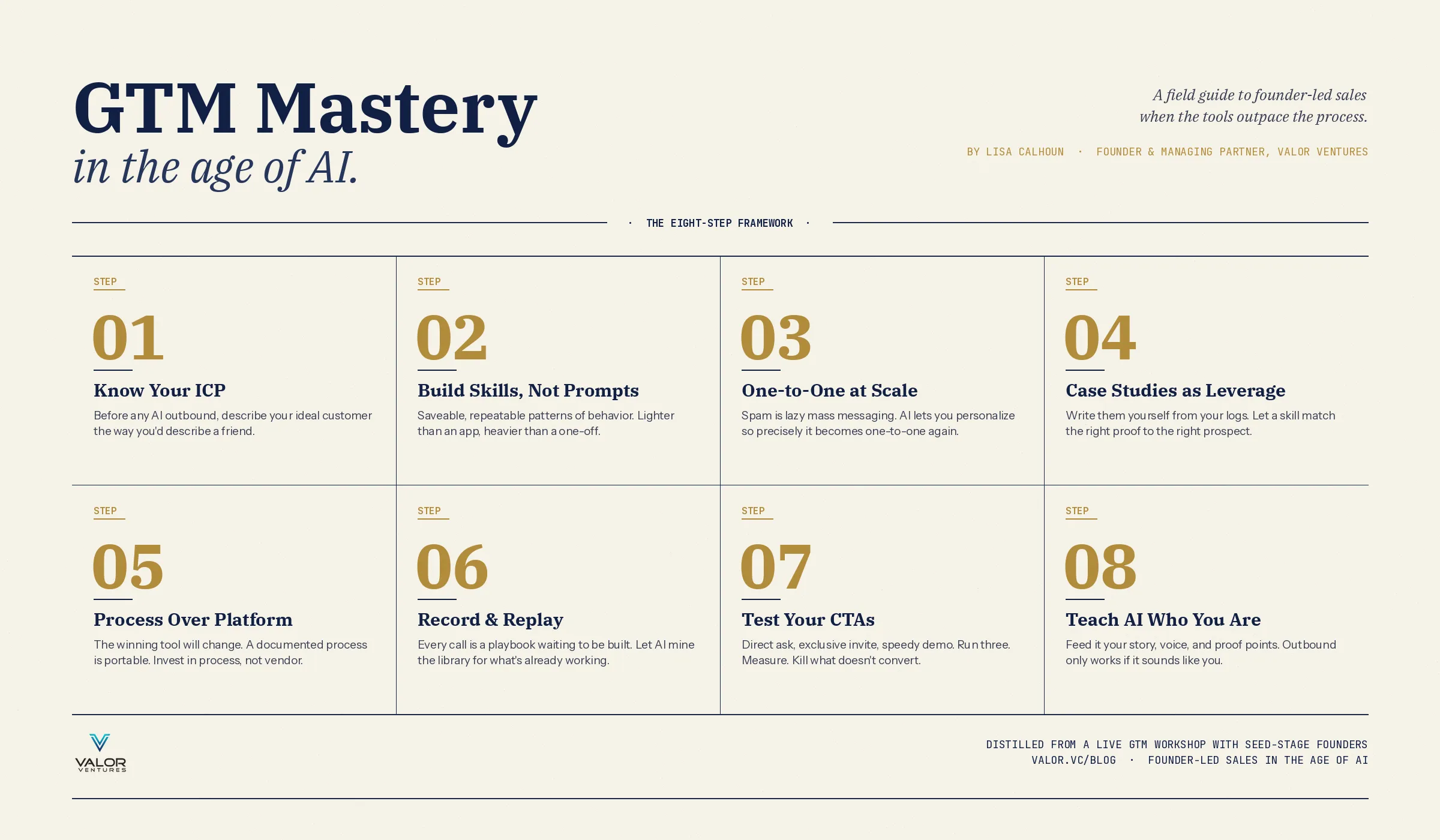
AI Go To Market Mastery In Founder-Led Sales
I just ran a hands-on AI go-to-market workshop with a room full of seed-stage founders — SaaS, marketplaces, deep tech, across the South and beyond. Every founder in that room was already using AI in some capacity. But almost none of them had built a repeatable, scalable sales process with it. That gap — between tinkering and operationalizing — is where the real leverage is.
Here's are the eight take aways that resonated most with the workshop.
1. Know Your ICP Before You Automate Anything
This sounds obvious, but it's the number one thing that trips founders up when they try to use AI for go-to-market. If you can't tell me in two sentences who your ideal customer is and how much you want them to spend with you per year, AI can't help you sell to them. It will just help you spam faster.
I pushed every founder in the workshop on this.
Some had it dialed. One founder knew his buyer was luxury custom home builders doing 15 to 20 projects a year, all north of a million dollars, with three or four FTEs and no one dedicated to permitting. That's specific. That's targetable. AI can work with that.
Others were vague. And that's okay — but it means the first job isn't building an outbound machine. It's narrowing the aperture until you can describe your best customer the way you'd describe a best friend.
2. Build Claude Skills, Not One-Off Prompts
The biggest unlock most founders haven't discovered yet is the concept of a skill — a repeatable, saveable pattern of behavior that you teach your AI to execute on command, or on a schedule.
A few of the founders in the room asked how to think of a skill, since they hadn't built one yet. A skill, like Claude uses, is lighter than an app. It is essentially a small, documented process that goes and picks up some stuff, does something with it, and delivers a result. You can tell it to run every Tuesday morning. You can tell it to put results in your Gmail drafts. You can iterate on it over time until it's dialed.
One founder in the workshop had built a scraper that pullsbuilding permit records daily to identify who's submitting permits over a certain dollar threshold. Great start. But the data was just sitting there. During the workshop, he prompted Claude to take that scraper output, look up each prospect's LinkedIn, personalize an email based on their building portfolio, and drop it into his Gmail drafts. He built and ran the skill live, in about 20 minutes.
His reaction: "I click send on those emails I created while we're on this call. It personalized emails, looked up my website, took the copy, gave us a value prop, personalized it towards the builders, and created this with a little CTA at the end. Pretty cool."
Pretty cool is right. And the skill is now something he can refine, schedule, and scale--scaling sales without having to hire just yet.
3. One-to-One at Scale Is the New Outbound
Here's the mindset shift I want every founder to internalize: the age of mass outbound is over. AI doesn't help you blast more messages. It helps you send the right message to the right person with the most relevant context — and do it repeatedly.
Think about it this way. Spam is a process of lazy mass messaging. AI actually allows you to personalize the message so much that it's one-to-one. That puts the burden back on us of being really good about what we know our value is. And that plays perfectly to the founder CEO.
LinkedIn caps you at a certain number of messages per day. Next Door limits you. Facebook limits you. Fine. If you're sending 30 hyper-personalized, context-rich messages a day from a founder who clearly understands the recipient's problem, your response rate will be dramatically different than what you'd get with 300 generic ones.
You want the best message to the best potential customer with the most relevant context for them.
One founder started prompting Claude to build a database of US fleet operators from Department of Transportation penalty records — companies with tire-related failures and safety violations. Within minutes he was cross-referencing that with LinkedIn profiles. He said: "I'm amazed by hearing everything and by chatting and doing everything right now with Claude and looking at a pretty vivid database."
That's not a CRM import. That's a founder using public data, AI, and domain expertise to build a precision-targeted prospect list from scratch in a single sitting. And where he can take it from there, shifts dramatically, as he uses his existing strong case studies. Speaking of case studies . . .
4. Case Studies Are Your Most Scalable Sales Artifact
If your customers love your product — and several founders in this workshop had near-100% conversion from demo to close — then your biggest miss is probably not having enough case studies.
You have the logs, so you have the data. Write a private use, internal only case study (or teach an AI to) for your next customer based on what you already know, then ask if they'll sign off on it. Most will, because it makes them look smart too. Some may not, but then you can still use it, generically, or privately in key one to one conversations.
For your outbound, build a skill that matches the right case study to the right prospect. When you reach out to a new potential customer, your AI picks the case study that's most like them — same industry, same scale, same pain point. That's how you make outbound feel personal without starting from zero every time.
One founder had four happy customers and one case study. I told him: you need four. And they don't all have to look the same. Different components, different angles, different proof points. The skill does the matching.
5. Process Matters More Than the Platform
Founders love to debate which AI is best. Claude vs. ChatGPT vs. Gemini. I get it — I use multiple tools myself. But here's my strong point of view: the question is the wrong question.
It's the process that you need to focus on. Because let's say that some other tool is the best thing next year. You can take your skill — because it's basically a documented process — and port it over. The most important thing for the CEO to know is what's the process that's working for the company in increasing sales at all phases, outbound, demo conversion, contracting speed, recognized ARR.
Your AI skill is portable. It's a set of instructions that any capable model can execute. The intelligence that built the skill and the logic behind it — that's yours. That's your competitive advantage. Not which chatbot you're paying for.
One founder in the room built her entire go-to-market automation in Google's ecosystem during the workshop — using Gemini, Google AI Studio, and NotebookLM. Different tools, same framework. The process is the asset.
6. Record Everything So Insights Accelerate
If you're in founder-led sales right now, every demo you run, every sales call you take, every pricing conversation you have — record it. Use Fireflies, use Loom, Granola, whatever joins your calls automatically.
Why? Because you're building a library. And that library becomes the foundation for everything.
You can have AI go back through your last week of recorded meetings and pull out what prospective customers liked, what confused them, what pushback you got. Summarize it. Send it to you on Fridays. Share it in your Monday standup. That's not just a time-saver — it's how you build a sales playbook without ever sitting down to write one.
And those recordings become content. A great 10-minute conversation with a customer on a webinar can be turned into a demo video, a blog post, a case study, social clips — all from one recording that you didn't have to script or produce. Once you realize you have the asset, there are half a dozen ways you'll find to use it.
7. Test Your CTAs Like a Scientist
Your call to action matters more than you think. One big take away was how many founders just think of one call to action. You should be running at least three variations--your favorite, and two to test. Here are the types that came up in the workshop that founders are testing right now.
The direct ask is a personal calendar link for a one-on-one conversation. Very executive. High-touch. Works when the relationship matters.
The exclusive invite is an invitation-only roundtable or webinar where you and a happy customer talk about the real stuff. One founder lit up when I suggested this: "I love that idea of the little roundtable. I wrote that down. I'm going to use that."
The demo offer is short, specific, and low-commitment. One founder closes nearly 100% from demo, so his entire outbound is built around getting to that 15-minute walkthrough.
Test all three. Measure response rates. Double down on what works. Kill what doesn't. Once you delete a CTA as not that useful, make sure you force yourself to creatively find a third option to test. AI is great for suggesting these types of things too. I even built a GPT to help you brainstorm on B2B sales tactics--access it here.
8. Tell Your AI Who You Are
This is a tip that most founders skip, and it's one of the highest-leverage things you can do. Before you build any outbound skill, make sure your AI knows who you are in as much detail as possible.
Ask it: who am I? Pay attention to what it tells you. Then correct it. Inform it. Tell it your story, your proof points, your voice, how you like to talk, what makes your company different. Get ridiculous with the detail.
Because when your AI researches a prospect and writes an email from you, it needs to actually sound like you. One founder shared a brilliant hack: he prompted his old ChatGPT instance to export a full profile of who he is, how he processes information, how he communicates — then fed that into Claude as a foundation. The self-awareness alone was valuable. The outbound that came from it was dramatically better.
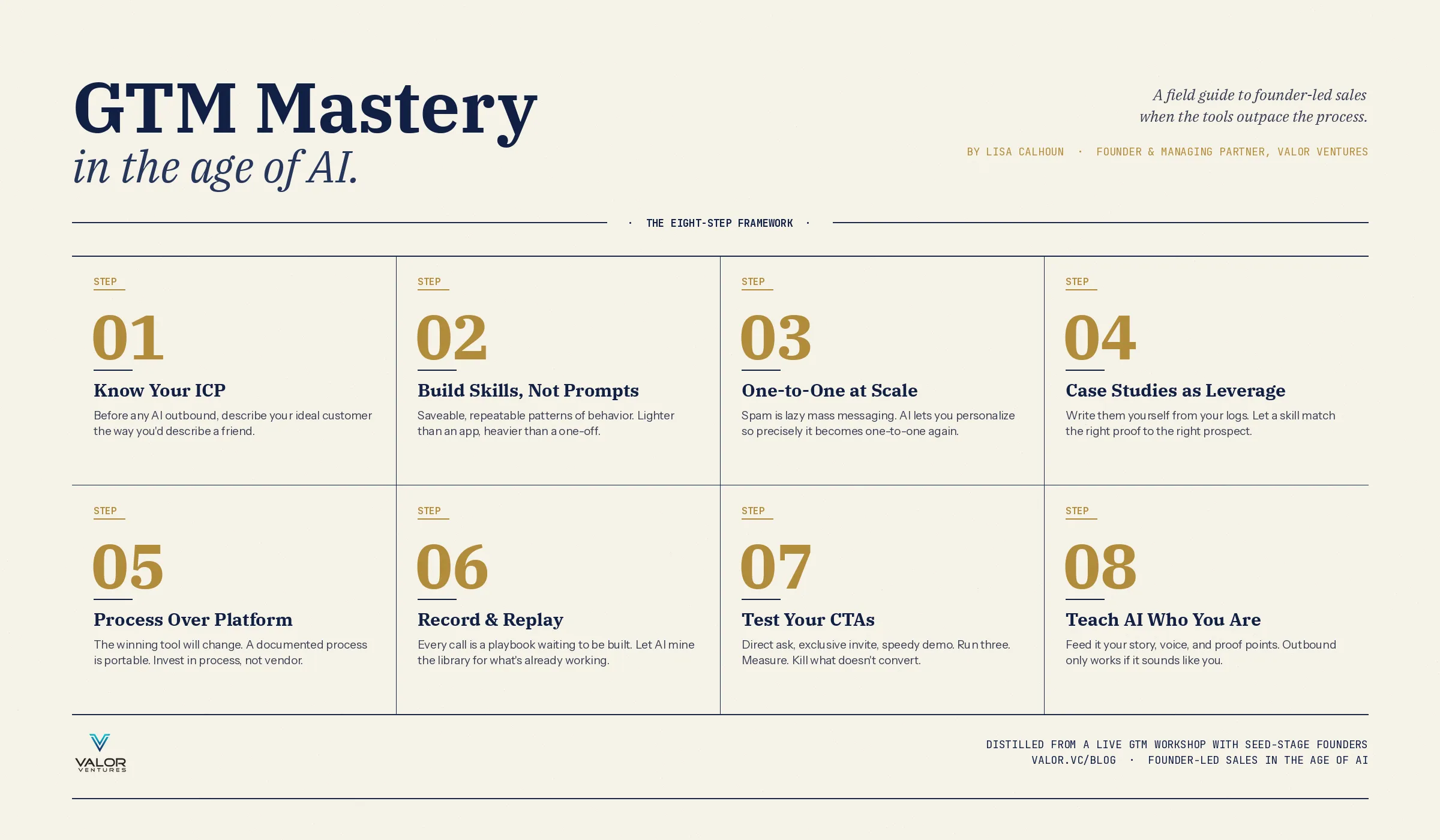
The Bottom Line on AI Go-to-Market for Founders
There aren't shortcuts to scaling. There are shortcuts to getting those first couple of customers, but there's no real shortcut to scaling. It's actually understanding your ICP, developing material they respond to, and then getting it out to them — consistently, personally, and at a pace that a founder can actually maintain.
What's different now is that AI compresses the cycle. You can build the prospect list, write the case study, personalize the outreach, draft the follow-up, and analyze what worked — all in the same sitting. That's not replacing founder-led sales. That's supercharging it.
One of the most technical founders in the room, summed it up perfectly: "What this made me think through is the two issues I have versus trying to do too much. You still got to slow down and make sure you commit to one of those things and build it, make sure it's running, test it, then move to the other one. Focus is kind of important because otherwise you'll be doing a lot, but it's not going to be effective. You want to be effective."
That's the whole game. Pick one skill. Build it. Test it. Measure your response rate. Beat it next week. Then build the next one.
The founders who win in the age of AI aren't the ones with the most tools or even the most tech savvy. They're the ones who turn their founder intuition into a repeatable process with patience — and then let AI run it while they go build the rest of the company.
Lisa Calhoun is the Founder and Managing General Partner of Valor Ventures, an early-stage VC firm based in Atlanta investing across the South. This post was distilled from a live GTM Mastery workshop with seed-stage founders on April 8, 2026.