
AI Changes Everything About Closing Enterprise Customers: 3 Ways Founders Win Now
Valor backs AI startups that sell to the enterprise at the first round. That means I spend some of every week inside the enterprise sales cycle. One thing I have noticed this year -- AI has rewritten everything about it.
Here are the three things that changed, and what the smart founders in our portfolio are doing instead.
1. Enterprise buyers have an AI budget, and they are eager to spend it
In the SaaS era, a startup had to earn its way up the food chain. You started with a department, proved yourself for a year or two, survived procurement, and maybe, eventually, got a real enterprise contract. It could take years.
That is not where we are.
Enterprise AI spend has graduated from the innovation budget to the real budget.
When a16z surveyed 100 enterprise CIOs, innovation budgets had fallen from a quarter of AI spending to just 7%, with the rest now sitting in core IT and business-unit line items, and those CIOs expected their AI spend to grow roughly 75% over the following year.[^1] Menlo Ventures puts 2025 enterprise spending on generative AI at $37 billion, more than triple the prior year, and finds that once an enterprise decides to explore an AI solution, 47% of those deals go to production versus 25% for traditional software.[^2] Gartner now forecasts AI software spending alone at $462 billion in 2026.[^3]
Christian Khoury, CEO of EasyAudit, a Valor portfolio company selling autonomous compliance into large enterprises, described the shift to me plainly:
"Large enterprise buyers are really becoming purposeful about where they allocate budget this year. They're explicitly calling out agentic AI. Not just AI, not generative AI, agentic AI specifically. They want digital workers."
His example was a 10,000-employee multinational whose CISO opened the first call by saying he wanted to run his whole compliance program with AI agents this year, with one person instead of five.
I do not think this pool of customer capital lasts forever. Depending on the industry segment, I expect it to tighten in the next year or two as CFOs start asking for the ROI on all of it. But while the getting is good, smart founders are skipping the free trial and signing pilot-to-enterprise contracts from the first conversation.
I wrote about exactly how in Kill the Free Trial: 3 Ways AI Founders Compress Their GTM and Close Their First Million.
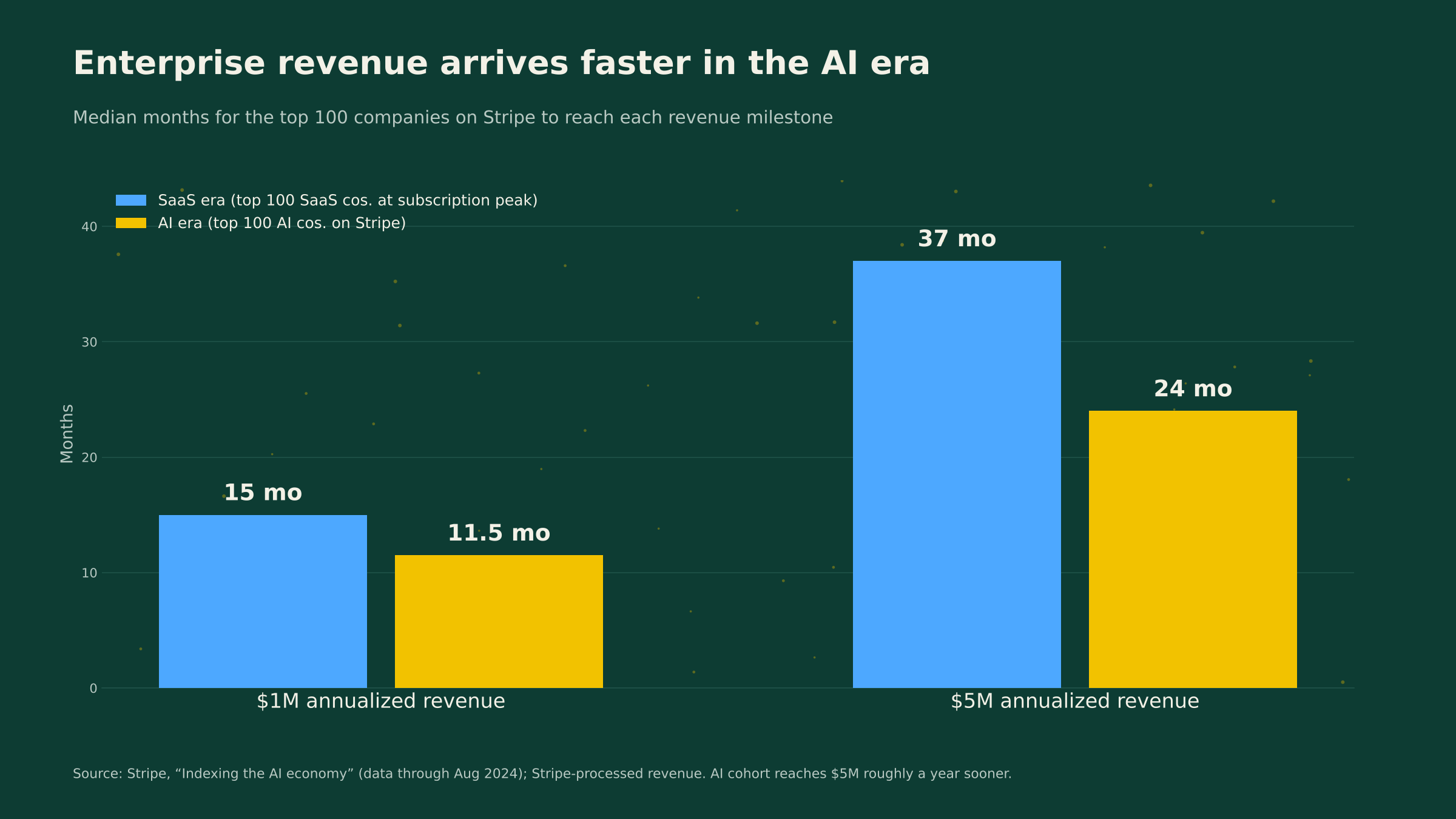
The data backs up what we see in the portfolio. Stripe compared the top 100 AI companies on its platform with the top 100 SaaS companies at the height of the subscription boom. The AI cohort reached $1 million in annualized revenue in a median of 11.5 months versus 15 for SaaS, and reached $5 million in 24 months versus 37.[^4] That is a year sooner to real revenue.
2. How enterprise buyers discover you has moved from the trade show floor to the chat window
It used to be that enterprise software sales, for a startup, was an in-person, event-driven grind. Only the big software companies had fleets of channel partners and sales folks to cover every conference and put on the big spreads. A startup's access to those buyers came one show at a time, mano a mano, booth by booth.
The numbers from that era tell the story. In 2019, more marketers named events the single most effective channel than any other, and half of companies were putting more than a fifth of their marketing budget into them.[^5] Even then, Gartner found enterprise buyers spent only 17% of their buying time meeting with potential suppliers, and predicted that by 2025, 80% of B2B sales interactions would happen in digital channels.[^6] That prediction aged well.
Christian's take on the trade show circuit is one I hear from a lot of our founders now: "Going to physical conferences has been, for us, a pretty one-to-one experience. You send someone, they talk to whoever's there, and that buyer is talking to fifty thousand booths. They might not even remember you."
What replaced the booth? The LLMs themselves. ChatGPT, Claude, Gemini and Google's AI Mode are now a significant source of referrals to AI solutions, and frankly to all solutions. Shiv Narayanan, founder and CEO of How To SaaS, shared a talk at Silicon Y'all last week, "The AI Imperative." He put hard numbers on something our founders--and I--have been feeling in pipelines all year. Three facts from Shiv's deck make the point:
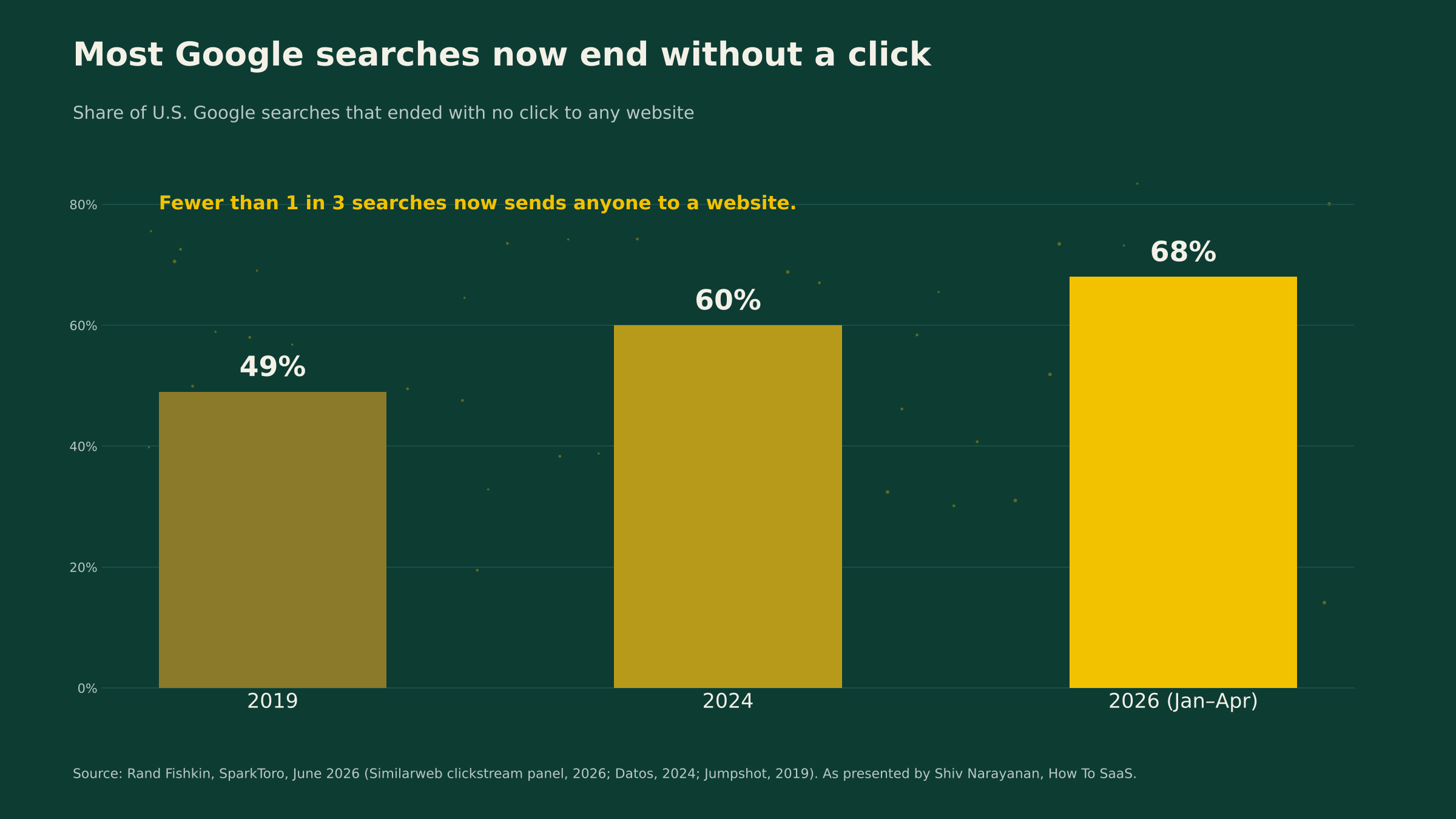
68% of U.S. Google searches ended without a single click in early 2026, up from 49% in 2019 and 60% in 2024, according to SparkToro's analysis of Similarweb clickstream data.[^7] Fewer than one in three searches now sends anyone to a website.
When Google shows an AI summary, users click a traditional result on only 8% of visits, versus 15% when there is no summary. Pew Research watched 68,879 real searches to get that number.[^8]
94% of B2B buyers use LLMs during their buying process, and in that study the median purchase was in the $200,000 to $300,000 range.[^9]
Forrester found twice as many buyers named generative AI a more meaningful source of information than any other source, ahead of vendor websites, product experts and sales reps.[^10]
What does a zero-click search mean in practice? It means the AI write-up sitting above the results was the answer, or the buyer looked at a page of sponsored links and decided ChatGPT or Claude was the easier path. Either way, the research that used to happen on your website now happens in a conversation you never see. One Valor portfolio company told its board this summer that its largest deal of the quarter came in 100% inbound from AI search. No rep, no booth, no cold email.
The founders winning here are not running ads harder. They are building a machine that turns what customers actually say into content the AI can find and quote. Christian described EasyAudit's version: "We pull the transcripts from the top sales calls we've had, the ones that really represent the ICP we want. We extract every pain point expressed in those calls and re-infuse them into creative. We test the creatives against each other, and the ones that perform best get the most capital allocation." That loop, customer language in, qualified pipeline out, is the new booth.
3. The buyer's first meeting with you is now the last stage, not the first
Here is the shift I think most founders are still underestimating, and Shiv lays it out well. In the old buying journey, a buyer identified a problem on their own and then spent three stages with you: exploring solutions, building requirements, and selecting a vendor. Your website, your demos and your reps had three shots at shaping the decision.
Now the buyer does problem identification, solution exploration and requirements building inside an AI conversation, and shows up to you only for final selection. Your window with the buyer shrank from three stages to one. The 6sense data agrees: buyers now make first contact with a vendor about 61% of the way through their journey, and the vendor they contact first wins roughly 80% of the time.[^9] Two-thirds of B2B buyers say they would prefer a rep-free buying experience altogether.[^11]
And the AI they consult does not take your word for it. Before it recommends you, it checks what everyone else says. Semrush's analysis of the domains cited by ChatGPT search, Perplexity and Google AI Mode found four sources carry 40% of all citations: Reddit, LinkedIn, Wikipedia and YouTube.[^12] If your customers are not talking about you in those places, the AI has nothing to repeat.
So the founders who are winning enterprise deals right now treat their reputation as a go-to-market asset. They publish their pricing, their security answers and their case studies where a model can read them instead of gating them behind a form. They ask for the G2 review at the moment of value. They show up in the Reddit thread and the LinkedIn comments as a person, not a promotion. They are not optimizing for a click. They are optimizing to be the name the AI says out loud when the CFO asks what a platform like this should cost for 200 seats.
Sell to the one committee member in every meeting
Put the three shifts together and the picture is clear. Enterprise buyers have the budget. They find you in a chat window. And every member of the buying committee, from the CEO to the end user, is consulting the same advisor at every stage, an advisor that never takes a meeting with you. That advisor is AI.
I think this is a flat-out exciting time to be an AI startup selling to the enterprise. For the first time, there is a buyer on every committee you can reach directly, at scale, without a booth, a channel partner or a fleet of reps. In the past, search was never considered an important early go-to-market strategy for an enterprise startup. The enterprise did not buy from Google results, and you could win big deals with a weak ranking. That era is over. As Shiv put it at Silicon Y'all last week, an AI search strategy is now both necessary and critical for any founder focused on enterprise customers.
Next week, I will dig into exactly how: the four things our fastest-growing founders publish so the AI on the committee says their name, and the order they do it in. Catch the next post in this series.
[^1]: Sarah Wang, Shangda Xu, Justin Kahl and Tugce Erten, How 100 Enterprise CIOs Are Building and Buying Gen AI in 2025, Andreessen Horowitz, June 10, 2025. "Last year, innovation budgets still made up a quarter of LLM spending; this has now dropped to just 7%." Enterprise leaders "expect an average of ~75% growth over the next year." [^2]: Tim Tully, Joff Redfern, Deedy Das and Derek Xiao, 2025: The State of Generative AI in the Enterprise, Menlo Ventures, December 9, 2025. Survey of 495 U.S. enterprise AI decision-makers. "47% of AI deals go to production, compared to 25% for traditional SaaS." [^3]: Gartner, Gartner Forecasts Worldwide AI Spending to Grow 49.5% in 2026, press release, September 16, 2026. AI software forecast: $288.2B (2025) to $461.6B (2026). [^4]: Stripe, Indexing the AI economy, data through August 2024; see also Lauren Thomas, Inside the growth of the top AI companies on Stripe, Stripe, June 30, 2025. Figures are Stripe-processed annualized revenue for the top 100 AI companies versus the top 100 SaaS companies at the height of the subscription boom. [^5]: Bizzabo, Event Marketing 2019: Benchmarks and Trends Report, 2019. 41% of marketers named event marketing the most effective channel, a plurality across nine channels; 50% of companies allocated more than 21% of marketing budgets to events. [^6]: Gartner, Gartner Says 80% of B2B Sales Interactions Between Suppliers and Buyers Will Occur in Digital Channels by 2025, press release, September 15, 2020. [^7]: Rand Fishkin, In 2026, Less than One Third of Google Searches Still Send a Click, SparkToro, June 8, 2026. "A whopping 68.01% of Google searches ended without a click" (U.S., January to April 2026, Similarweb panel); 60.45% in 2024 (Datos) and 49% in 2019 (Jumpshot). Chart as presented by Shiv Narayanan, How To SaaS, "The AI Visibility Imperative," 2026. [^8]: Athena Chapekis and Anna Lieb, Google users are less likely to click on links when an AI summary appears in the results, Pew Research Center, July 22, 2025. 900 U.S. adults, 68,879 searches, March 2025. [^9]: 6sense, 2025 B2B Buyer Experience Report: How AI Is (and Isn't) Disrupting Buying Journeys, 2025. 94% of buyers use LLMs or generative AI in the buying process; median purchase $200,000 to $300,000; first vendor contact at roughly 61% of the journey; the first-choice vendor wins about 80% of the time. [^10]: Forrester, B2B Buyers Make Zero-Click Buying Number One, Forrester Buyers' Journey Survey, 2025. "Twice as many buyers named generative AI or conversational search as a more meaningful or important source of information than any other source." [^11]: Gartner, 2026, as cited in Shiv Narayanan, "The AI Visibility Imperative," How To SaaS, 2026: 67% of B2B buyers prefer a rep-free buying experience. [^12]: Semrush, domains cited by ChatGPT search, Perplexity and Google AI Mode, January 2026, as presented in Shiv Narayanan, "The AI Visibility Imperative," How To SaaS, 2026: reddit.com 11.29%, linkedin.com 11.03%, wikipedia.org 9.53%, youtube.com 8.77%.