Building AI That Matters: The Startup Plot Shift For 2027
This afternoon I got off a call with a seasoned serial founder — YC and Techstars credentials, building in Miami. He's the newest niche entrant in an AI submarket that is exploding: several venture-backed players in his space are already past $1B in revenue. He's thoughtful and intense, and I enjoyed walking through the journey he expects to share with his earliest investors — potentially Valor. He told me two things I hear more often than you might guess. He plans to build this company for well over a decade. And a few of his potential acquirers are companies he'd never sell to, because of a values difference.
The 2027 M&A Market Founders Are Actually In
He also didn't realize some of the following facts, which should shape more reality for Southern founders than they do:
- More than 85% of venture-backed exits happen through M&A. Only 66 VC-backed companies went public in 2025 — the fewest since 2016 — and the IPO bar now sits near $100M in ARR and a $1.5B+ valuation. Almost nobody clears it.
- 2025 was the biggest year for SaaS M&A ever recorded. Software Equity Group tracked nearly 2,700 SaaS transactions, up 28% over 2024.
- AI is the accelerant. AI acquisitions hit 782 deals in 2025, roughly 1.5x the prior year, and Q1 2026 posted 266 AI M&A deals — up 90% year over year. Corporates have decisively chosen buy over build.
- The capital behind you needs the exit. With distributions at generational lows (2018 vintage funds sit near 0.6x DPI), every real VC on your cap table is underwriting your next round against a plausible acquisition, whether they say so or not.
I see across our portfolio that founders who internalize these realities early — not as a fallback, but as a design constraint — are raising better rounds, running better companies, and positioning themselves to be the headline acquisition in their category.
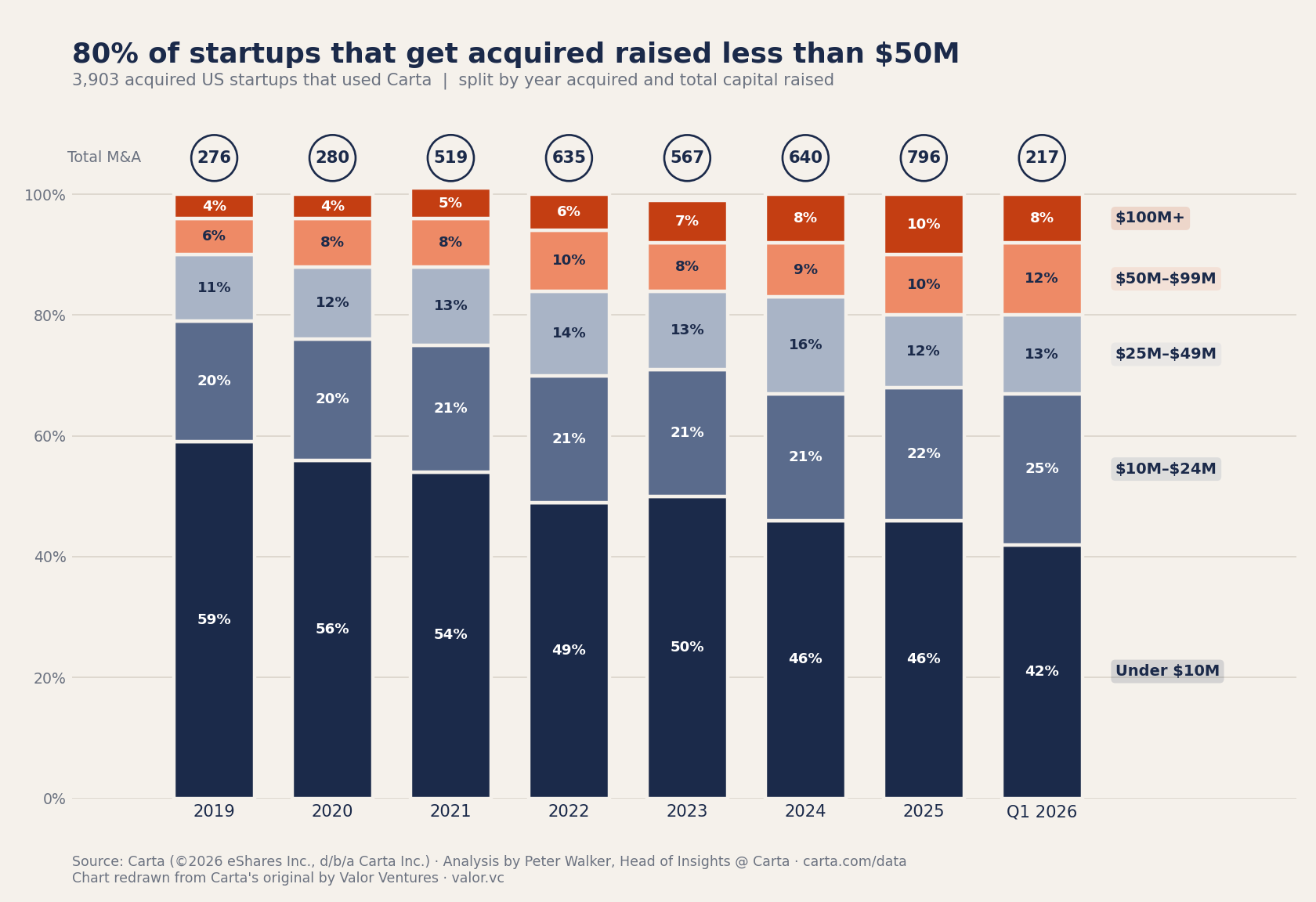
Look at who actually gets bought. Carta's data on 3,903 acquired US startups shows M&A volume nearly tripling from 276 deals in 2019 to 796 in 2025 — and 80% of the companies acquired had raised less than $50M.
- The exit doorway is widest for capital-efficient companies, not the most-funded ones.
Every discipline an acquirer pays a premium for — retention, predictability, margin, clean books — also makes you a better standalone company.
Build for the Highest-Value Exit in Your Sector
The most visible, most attractive opportunity for founders and their earliest investors alike is building toward the highest-value strategic exit in your sector. That's the headline acquisition — the deal that defines a category and reprices everyone else in it.
Strategic alignment routinely commands a 30–50% premium over financial buyers.
Example:
- Alphabet paid $32B for Wiz,
- Palo Alto paid $25B for CyberArk,
- ServiceNow paid $3B for Moveworks.
A strategic isn't buying just your cash flow — they're buying your position, your data, your talent, and 12–24 months they can't afford to spend building.
It's also important to note private equity is the higher-volume buyer — PE represented nearly 58% of SaaS deal participation in 2025 — but read that statistic correctly. PE is where companies land when they can't clear the strategic bar: solid businesses trading in the 4–6x revenue middle of the market, often with earn-outs attached. It's a real option, and sometimes the right one for a company that has plateaued. It is not what you architect for.
What Top Strategics Screen Startups For
- Logo churn below 3% annually puts you in the 8–12x ARR conversation. At 8% churn, comparable companies clear roughly half that. One published comp: two $6M ARR companies, both growing 25% — the one with 2% churn and 118% NRR priced at 9x; the one with 8% churn and 94% NRR priced at 4.5x. Same revenue, same growth, half the price.
- Net revenue retention above 115–120% signals customers expanding on their own — the single strongest predictor of premium multiples in AI-native deals. I see so many pitch decks at Series A with "105% logo retention" — not even realizing they are promoting their plateau, which is how that reads.
- Gross margins above 65% fully loaded — including inference costs. Buyers are now modeling your AI compute bill before they model your synergies.
- Embedded, mission-critical workflow. The leading deal categories reward high switching costs and durable retention, not seat counts.
- Proprietary data and vertical depth. Horizontal AI gets built internally; vertical AI gets bought. Three years of proprietary transaction data in one industry is the asset an acquirer cannot replicate at any speed.
Founders: 5 Takeaways for 2027 M&A Optionality
With the market moving this fast, this is what I share with Southern founders I care about:
- Draw your exit map now. Name the ten most plausible acquirers of your company — starting with the richest strategic outcome in your sector. Convert at least three into customers, channel partners, or design partners by mid-2027. Acquirers overwhelmingly buy companies they already touch.
- Re-architect revenue for predictability. Targets for the year: NRR at 115%+, logo churn under 3%, majority of ARR on multi-year paper, no concentration above 15%. This is the difference between 4.5x and 9x on identical revenue.
- Get AI-native or get repriced. Your product should be inoperable without its AI, fed by proprietary vertical data that compounds, at 65%+ gross margin after inference. Anything less is a feature, and features trade at today's anemic SaaS multiples.
- Run diligence-ready as an operating system. Clean GAAP financials, buttoned-up IP assignments, SOC 2, documented model training and data provenance. Deals in this market take 6–12 months with 10–20% held in escrow — sloppiness gets priced against you twice. Two of our portfolio companies live exactly here: EasyAudit is best in class at turning SOC 2 and other frameworks buyers demand into a trust system rather than a scramble, and Arpio runs enterprise disaster recovery for the AI era — the resilience posture acquirers now diligence alongside security.
- Never let one buyer set your price. Inbound interest is flattering and expensive. Competitive tension — a real process, a good banker, multiple strategics at the table — is where the 30–50% premium actually gets captured. Valor introduces top tier investment banks early to our portfolio to start building this muscle.
The Southern Advantage Is Built for This Market
The founders I want to back aren't building to be bought. They're building AI-era software that expands and accelerates until it defines its industry — which is precisely what makes a headline acquisition instead of a quiet one. In this market, those are the same company.
If that's you, and you're building in the South, we should compare notes. Drop your deck to Vic, our 24/7 AI analyst, at valor.vc/#deckcheck for fast, detailed feedback.
Footnotes
Additional sources: Carta / Peter Walker, acquired-startup capital-raised analysis (carta.com/data); SEG 2026 Annual SaaS Report (record ~2,700 deals, +28%; PE at ~58% of deal participation); FE International (Q1 2026 AI M&A volume, strategic premium range, mega-deal comps); Livmo (churn benchmarks).